


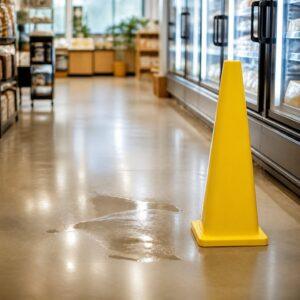
Walking down the aisle of a New York supermarket, big-box retailer, or neighborhood shop, the last thing you expect is for your feet to go out from under you. Yet a slip and fall in a store happens every day, often causing back injuries, broken bones, head trauma, and months of physical therapy.
When a spill, leak, or freshly mopped floor causes an injury, many people assume the store is automatically responsible. Under New York premises liability law, though, proving that you slipped on a wet floor usually isn’t enough. In most cases, you must show that the store created the hazard, or that it knew or should have known about it and failed to clean it up or warn customers in time.
That is where the difference between actual and constructive notice comes in, and why it pays to understand it before you talk to the store’s insurance company.
Understanding Premises Liability Standards in New York Retail Stores
Property owners and commercial tenants in New York City, Long Island, and Westchester County must keep their premises in a reasonably safe condition. In practice, that means inspecting floors regularly, cleaning up hazards promptly, and warning shoppers about dangers that can’t be fixed right away.
When a store falls short of that standard and a customer gets hurt, the injured person may be able to pursue compensation for a slip and fall in NY. Defense attorneys and insurance adjusters, however, routinely argue that management had no idea the hazard was there. Overcoming that defense means establishing one of the legal paths to liability below.
Case Today (212) 977-2020
Actual Notice vs. Constructive Notice: What’s the Difference?
To hold a store responsible in New York, your legal team generally must show one of three things: the store created the hazard, the store had actual notice of it, or the store had constructive notice of it.
When the Store Created the Hazard (No Notice Required)
If the store or its employees created the dangerous condition, such as mopping a floor during business hours, over-waxing tile, or leaving cleaning residue behind, you do not have to prove notice at all. A business that creates a hazard is already aware of it. Showing that staff performed the unsafe cleaning or maintenance is often the most direct route to liability.
Actual Notice: When the Store Already Knew
Actual notice exists when a manager or employee knew about the hazard before your accident.
- Examples: A customer tells a cashier that a jar of olive oil shattered in aisle 4, or an employee walks past a puddle of milk and decides to deal with it later instead of blocking it off or putting out a caution sign.
- Proving it: Actual notice is usually shown through eyewitness testimony, employee incident reports, internal store communications, and video recordings.
Constructive Notice: When the Store Should Have Known
In many cases, no one told staff about the spill beforehand. That is where constructive notice applies. Under New York law, a store has constructive notice if the dangerous condition was visible and apparent and existed for a sufficient length of time before the accident that employees, using reasonable care, should have discovered and corrected it.
- Proving it: If a puddle of melted ice cream has footprints and cart tracks running through it and dirt settling at the edges, that is strong evidence it sat there long enough for employees to notice during routine floor checks. Store surveillance footage and floor inspection or maintenance logs become critical evidence here.
Common Causes of Retail Slip and Falls Beyond Spills
Dropped groceries and spilled drinks are common culprits, but many retail slip and falls stem from maintenance and equipment problems:
1. Freshly Mopped Floors Without Caution Signs
Cleaning crews often mop high-traffic tile or linoleum during business hours. Without clearly visible “Caution: Wet Floor” signs, a freshly mopped aisle becomes a trap for shoppers who have no reason to expect it.
2. Leaking Refrigeration Units and HVAC Condensation
Supermarkets and convenience stores rely on commercial refrigeration. When drain lines clog or seals fail, water can pool beneath display cases where it blends into polished flooring. If a cooler has a history of leaking and management knows it, but only mops up the water instead of fixing the problem, that recurring condition can establish notice under New York law.
3. Tracked-In Snow, Slush, and Rainwater in Entryways
During New York winters and heavy rainstorms, water gets tracked into vestibules and checkout areas. Under New York’s storm-in-progress rule, stores generally are not expected to keep floors perfectly dry while precipitation is still falling. Once the storm ends, however, they must take reasonable steps within a reasonable time, such as putting down mats and addressing dangerous pooling. Failing to do so can support a claim.
4. Floor Cleaning Product Residue and Over-Polishing
Sometimes a floor isn’t wet at all. It’s slippery because staff used too much wax, stripping agent, or cleaning product during maintenance. Because the store created that condition, notice usually isn’t required.
How to Build a Strong Slip and Fall Case with Objective Evidence
Evidence gathered right after the accident can make a significant difference. If you are able to, take these steps (and see our guide on what to do after a slip and fall in a NYC store):
- Photograph the scene and the hazard: Take wide shots of the aisle and close-ups of the liquid, footprints, missing warning signs, or leaking equipment.
- Preserve surveillance footage: Many stores record their aisles, and recordings are often overwritten within days or weeks. An attorney can send a preservation letter demanding the store keep the footage.
- Report the incident: Ask the manager to complete an incident report, and request a copy or write down the report number before you leave.
- Collect witness information: Independent witnesses can be key to showing how long a spill sat on the floor.
- Get medical care and talk to a lawyer: Prompt treatment protects your health and documents your injuries. An experienced slip and fall lawyer in NYC can obtain store logs, maintenance records, and expert testing that you can’t get on your own.
Protect Your Rights with Chaikin Trial Group
A slip and fall in a store can upend your life in seconds, leaving you with medical bills, lost wages, and ongoing pain. You do not have to deal with the store’s insurance company alone.
Chaikin Trial Group represents injured people across New York City, Long Island, and Westchester County. If a store’s negligence caused your fall, our premises liability lawyers in NYC are ready to investigate and hold the property owner accountable.
Contact us today for a free, confidential consultation.